What robots learned from Bharatanatyam about technology itself
A 2025 study found mudras teach robots better than natural movement. This piece examines what that means for SaaS products that work but are not understood.
We keep trying to make technology more human
But most of the time, we misunderstand what that actually means. When people say “human-like,” they usually mean natural. Messy, adaptive, grounded in real-world behavior.
So we build systems that mimic how humans move, decide, and interact. We assume that if technology behaves like us, it will understand us better.
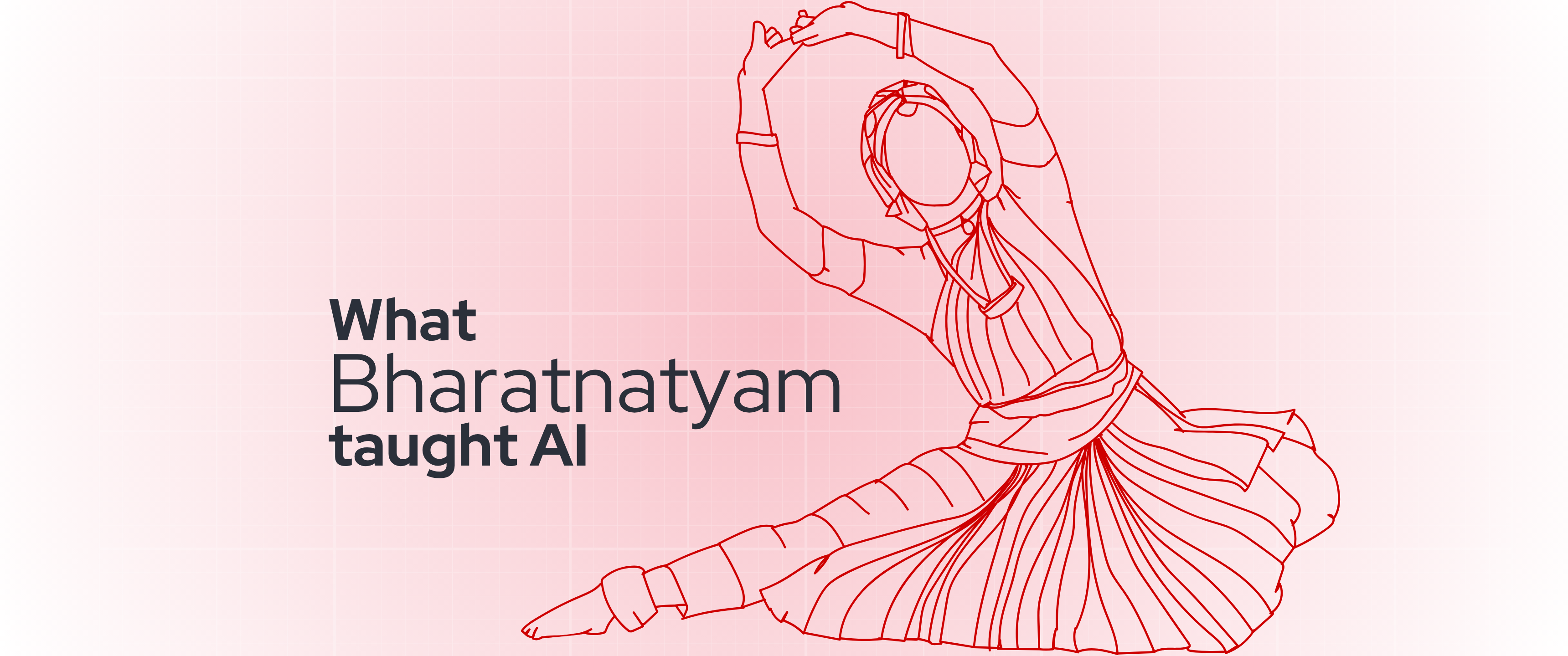
A 2025 study published in Scientific Reports by researchers at the University of Maryland Baltimore County quietly challenges that assumption. Instead of training robots only on natural hand movements, researchers introduced Bharatanatyam. Not as culture or performance, but as a system of codified gestures. The result was unexpected. The robot learned and reproduced gestures more accurately when trained on mudras than on natural movement.
At first glance, this feels like a niche insight. It isn’t
Because art is not random. It is distilled human experience
Natural behavior is efficient. It helps us get things done, but it is rarely structured for interpretation. Art exists for the opposite reason. It takes something fluid and turns it into something structured.
A gesture becomes a mudra. A sound becomes a note. A feeling becomes a sentence. In that transformation, something important happens. The experience becomes transferable.
That’s what the robot actually learned. Not just movement, but a system of meaning.
Technology, as we build it today, is still closer to instinct than to art
Most modern systems are designed for execution. They optimise for speed, efficiency, and output. Even in AI, the dominant approach is to train on large volumes of natural data and let patterns emerge.
It works, but it creates a limitation. The system becomes good at responding, but not necessarily at explaining. Good at performing, but not always at structuring meaning.
You see this everywhere. Interfaces that work but feel overwhelming. Products that are capable but hard to grasp. Tools that solve problems but don’t help users understand them. This is where technology starts to feel unintuitive, even when it’s technically correct.
This limitation becomes especially visible in SaaS products, where even strong functionality often struggles to translate into clear product storytelling or intuitive user understanding.
Art solves a different problem than technology does
Technology asks how to make something work. Art asks how to make something understandable. That difference is easy to ignore until you try to scale.
Scale is not just about doing more. It is about being understood repeatedly. This is why notation exists in music, choreography in dance, and grids in design.
These are not constraints. They are frameworks that allow meaning to travel. Without them, every experience would need to be rediscovered from scratch.
The systems that endure are the ones that structure meaning
If you look closely, the most influential systems we interact with are not the most complex ones. They are the ones that feel obvious in retrospect.
Language, mathematics, interface patterns. All of them compress complexity into forms that can be learned, reused, and extended.
That is what Bharatanatyam did for the robot. It gave it a vocabulary instead of just examples. And vocabulary scales differently than behavior.
This is where most modern products quietly struggle
Not because they don’t work, but because they rely too heavily on users to interpret them. They assume that if something is useful, it will eventually be understood.
But “eventually” is a luxury that no longer exists. Users don’t spend time decoding systems anymore. They adopt what makes sense quickly and ignore the rest.
So the bottleneck shifts from capability to comprehension. This is particularly evident in SaaS onboarding experiences and product-led growth systems, where users adopt one workflow but rarely move beyond it.
The real role of design, storytelling, and communication
This is where the conversation often gets reduced to aesthetics or content. But the role is much deeper. Design is not just about how something looks. Storytelling is not just about how something is said. They are mechanisms for structuring meaning.
They take something complex and make it graspable, memorable, and shareable. In SaaS marketing strategy, this is where explainer videos, onboarding content, and GTM communication start playing a much more critical role than most teams assume.
In that sense, they are much closer to art than execution. And that’s exactly why they matter more as systems become more complex.
The Bullseye Perspective
At TheBullseye, this is the shift we keep coming back to.
Not how do we make something more visible, but how do we make it make sense faster, and more importantly, how do we make that understanding hold across contexts. Because clarity is often misunderstood as simplification. But that’s not what’s happening here. What we’re really talking about is structuring meaning in a way that can travel.
Most products today communicate like natural behavior. Each touchpoint exists in isolation. An ad introduces one idea. A landing page explains another. The product interface reveals something else. Sales conversations rebuild context from scratch.
Individually, each piece might work. But collectively, they don’t form a system. So users don’t experience the product as a coherent whole. They experience fragments. And when understanding is fragmented, decision-making slows down.
This is where art offers a more useful model than engineering. In Bharatanatyam, meaning is not attached to a single gesture. It emerges from the relationship between gestures. From sequence, repetition, and context. The system teaches you how to interpret it over time.
That’s what most SaaS products lack.
They communicate features, but not progression. They show capability, but not structure. They rely on users to connect the dots, instead of designing how those dots should connect. And that’s exactly where breakdown happens.
When we work with SaaS teams on video, product storytelling, and SaaS video marketing systems, the shift is rarely about adding more content. It’s about aligning what already exists into a structure that compounds across the funnel.
A SaaS explainer video is not just an asset. It becomes the first layer of interpretation. Onboarding content reinforces that mental model. Sales conversations validate what the user already understands.
When these layers are disconnected, every interaction feels like a restart. But when they’re structured, understanding builds. It carries forward. It reduces the effort required at every step.
That’s when you start seeing second-order effects.
Sales cycles shorten because context is established earlier. Feature adoption improves because users understand when and why to use something. Retention strengthens because value becomes clearer over time. None of this is accidental. It is the result of treating communication as a system, not as output.
The Takeaway
The most important insight from this research is not about robotics or dance. It is about how systems evolve from working to scaling. Natural behavior will always get you to a functional solution. It is adaptive, efficient, and grounded in reality. But it does not inherently create repeatability. And repeatability is what growth depends on.
Bharatanatyam did not make the robot more human. It made the system more interpretable. It introduced structure where there was previously variation.
That’s a very different kind of improvement. And it points to something that is becoming increasingly relevant in technology. As systems become more powerful, the bottleneck is no longer capability. It is comprehension.
Not what the system can do, but how quickly and consistently that ability can be understood across different users and contexts. This is where SaaS video marketing, onboarding systems, and product storytelling become critical levers rather than supporting assets.
This is why so many products today feel harder than they actually are. Not because they are poorly built, but because they are poorly structured in how they present meaning.
We tend to assume clarity emerges with time. That users will eventually understand. But that assumption is breaking. Users do not invest time in figuring things out anymore. They make decisions based on what is immediately interpretable. And if that interpretation is incomplete, they move on. So the question shifts.
From how do we build something powerful, to how do we make that power legible?
That is where art becomes relevant again. Not as decoration, but as a discipline of structuring complexity into something that can be understood, remembered, and reused. The systems that will define the next phase of technology will not just be the most advanced. They will be the most interpretable.
Because interpretation is what allows systems to scale without breaking. And that’s the real takeaway.
Technology does not become more effective by becoming more human in the way we behave. It becomes more effective when it learns from how humans structure meaning.
Sources
- Vinjamuri et al., University of Maryland Baltimore County: 'Reconstructing hand gestures with synergies extracted from dance movements'. nature.com/articles/s41598-025-25563-7, 2025.
Rishabh Poddar
Co-Founder
Co-founder at TheBullseye, working with SaaS companies to improve user adoption, onboarding, and the overall buying experience. With a background across sales, product, analytics, and UX, he approaches CX as a system, not a layer—helping teams align product, marketing, and sales around clarity that converts.
FAQs
Bharatanatyam is one of the oldest classical dance forms of India, originating in Tamil Nadu and practiced for more than two thousand years. It is structured around a codified vocabulary of gestures, postures, footwork, and facial expressions, each carrying specific meaning. The hand gestures, called mudras, are its most distinctive feature: there are 28 single-hand gestures and 24 combined-hand gestures, each encoding a defined meaning or narrative function. This codification is what distinguishes Bharatanatyam from natural or improvised movement. Every gesture belongs to a grammar, and that grammar makes meaning transferable across performers and audiences.
Mudras are codified hand gestures used in classical Indian dance forms, where each gesture carries a defined meaning within a structured vocabulary. They matter for machine learning because they represent a fundamentally different kind of training data from natural movement. Instead of recording how hands move spontaneously, mudras encode how hands should move to express a specific meaning. When researchers used mudra data to train robots, the structured gesture system gave the model a cleaner signal than naturalistic data. The robot was not learning from variation. It was learning from a vocabulary.
Researchers found that robots trained on Bharatanatyam mudras learned and reproduced gestures more accurately than robots trained on natural hand movements. The key finding was that structured, codified gesture data produced better learning outcomes than naturalistic behavioral data, even though natural movement data is more voluminous and seemingly more representative of how humans actually move. The structure of the training data, not just its quantity or naturalness, significantly affects what a system can learn and generalise.
Structured meaning in SaaS products refers to the deliberate organisation of how a product's value, function, and context are communicated across every touchpoint a buyer or user encounters. It is the opposite of fragmented communication, where an ad introduces one idea, a landing page explains another, and onboarding starts from scratch. A product with structured meaning creates a consistent interpretive framework: users understand what the product does, who it is for, and why it matters, and that understanding compounds rather than resets at each new interaction.
SaaS products feel hard to understand when they are designed for execution rather than interpretation. The product solves real problems, but the way it presents itself does not create a clear mental model for the user. Features are communicated without a progression that tells users when and why to use them. Interfaces show capability without showing structure. The result is a product that works but requires users to invest significant effort in figuring out how to think about it, and in 2026, most users will not make that investment.
Capability refers to what a SaaS product can do: the features, integrations, and outcomes it delivers. Comprehension refers to whether a buyer or user understands what the product can do, in a way that is fast, consistent, and reliable across different people and contexts. Most SaaS marketing focuses heavily on capability because it is easier to demonstrate. Comprehension is harder to design for, but it is what determines whether that capability actually converts, gets adopted, and drives retention over time.
A SaaS explainer video functions as a communication system by establishing the first and most durable mental model a buyer or user forms about the product. When the explainer is well-structured, it does not just introduce the product: it creates a framework of interpretation that subsequent touchpoints reinforce. Onboarding content can build on the same mental model. Sales conversations can validate what the user already understands. When these layers are aligned, understanding compounds across the funnel. When they are not, every interaction feels like a restart.
For most SaaS products today, the primary bottleneck is comprehension, not capability. Products are often more technically sophisticated than users can readily adopt, because the gap is not in what the product can do but in how quickly and consistently that ability can be understood. The bottleneck shifts from capability to comprehension when a product is functional enough to solve the problem but is not structured in a way that allows different users to reach that solution without significant effort on their part. This is where product storytelling, onboarding systems, and SaaS video marketing become critical levers rather than supporting assets.